Natural stone has long played an important role in architecture and interior design, offering a combination of natural beauty, material character, and lasting appeal. Among the many decorative stones available, onyx stands out for its distinctive color patterns, layered appearance, and remarkable ability to transmit light.
Unlike conventional building stones that are primarily selected for strength and durability, onyx is often chosen for its visual impact. Its translucent structure allows designers to create illuminated walls, decorative panels, countertops, and statement features that introduce depth and atmosphere into interior spaces.
From elegant residential bathrooms to luxury hotels, restaurants, and commercial interiors, onyx stone offers a distinctive design solution. However, its relatively delicate nature means that material selection, fabrication, installation, and maintenance require careful consideration.This guide explores the formation, colors, properties, applications, finishes, and practical considerations of using onyx in architectural and interior design projects.
What Is Onyx Stone?
Onyx used in architecture and interior design is commonly known as onyx marble or banded calcite. It is a decorative natural stone primarily composed of calcium carbonate, usually in the form of calcite or, in some cases, aragonite.
Unlike black onyx used in jewelry, which is a variety of chalcedony composed of silica, architectural onyx belongs to a different mineral category. Understanding this distinction is important when evaluating its physical properties and suitable applications.
How Is Decorative Onyx Formed?
Decorative onyx forms through the gradual deposition of calcium carbonate from mineral-rich water, particularly in caves, springs, and other environments where carbonate-rich water circulates.
As water moves through these environments, dissolved minerals precipitate and accumulate in successive layers. Over extended periods, these deposits develop into the characteristic bands and patterns associated with onyx.Differences in mineral impurities, deposition conditions, and crystal structures contribute to the stone’s wide range of colors and visual variations.
The resulting material often displays:
- Parallel or curved mineral bands.
- Translucent and opaque areas.
- Contrasting color layers.
- Natural veins and crystalline structures.
- Distinctive patterns that vary between slabs.
What Makes Onyx Stone Translucent?
One of the most recognizable characteristics of onyx is its ability to transmit light through parts of its structure.The degree of translucency depends on several factors, including mineral composition, crystal structure, impurities, and slab thickness. Some varieties allow light to pass through more effectively than others.
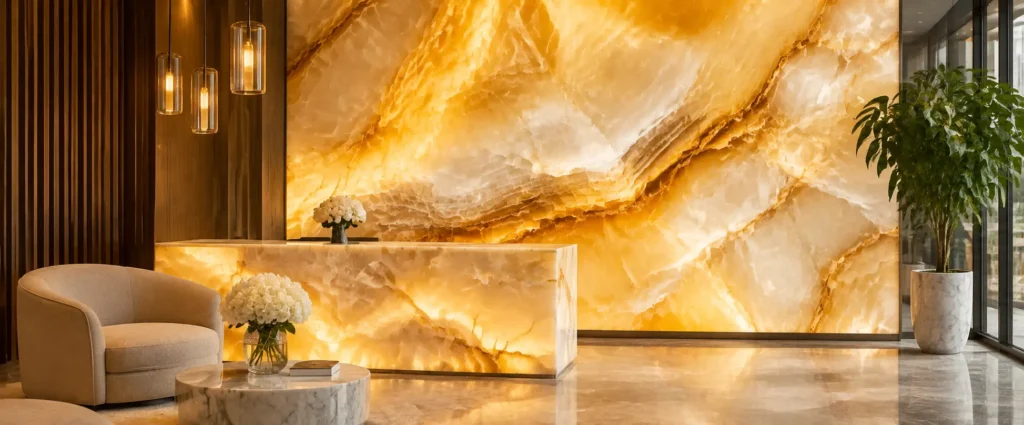
This characteristic makes onyx particularly suitable for backlit architectural features. When an appropriately selected slab is illuminated from behind, its natural bands and internal patterns become more visible, creating a distinctive visual effect.
Not every onyx slab has the same light transmission properties. Therefore, evaluating the actual slab under backlighting is recommended before selecting material for an illuminated installation.
Onyx Marble vs. Black Onyx
The word onyx is used for two different natural materials in the stone and gemstone industries.
| Characteristic | Architectural Onyx | Black Onyx Gemstone |
|---|---|---|
| Main Composition | Calcium carbonate | Silica |
| Mineral Type | Mainly calcite or aragonite | Chalcedony |
| Typical Appearance | Layered bands and translucent patterns | Usually uniform black appearance |
| Common Applications | Interior surfaces and architectural decoration | Jewelry and ornamental objects |
| Light Transmission | Often translucent | Generally opaque |
In this article, the term onyx refers exclusively to architectural decorative onyx used in natural stone projects.
Types of Onyx Stone and Their Colors
Color is one of the main factors influencing the appearance and commercial appeal of onyx. Natural mineral deposits produce different shades and patterns, ranging from soft white and cream to rich honey, green, pink, and brown.The names used in the commercial stone market generally describe the dominant color, visual pattern, or quarry origin rather than a completely separate mineral classification.
| Onyx Type | Color and Appearance | Main Design Characteristics | Common Applications |
|---|---|---|---|
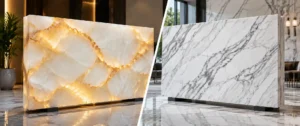
| White Onyx | White, cream, with subtle gray or beige veining | Bright appearance, delicate patterns, suitable for backlighting | Backlit wall panels, bathroom vanities, decorative partitions, reception areas |
| Honey and Golden Onyx | Golden, amber, yellow, and caramel tones | Warm colors, distinctive natural bands, enhanced visual depth under illumination | Hotel reception walls, bar fronts, fireplace surrounds, illuminated panels |
| Green Onyx | Pale mint, olive, and deeper green shades | Distinctive layered patterns, natural contrast, complements wood and metallic finishes | Decorative walls, countertops, luxury interior features |
| Red and Pink Onyx | Rose, peach, salmon, and reddish tones | Expressive colors and prominent natural banding | Decorative installations, feature walls, statement interior elements |
| Brown and Multicolored Onyx | Beige, caramel, amber, gray, and darker mineral bands | Multiple color combinations and complex natural patterns | Feature walls, decorative panels, luxury interiors with wood and metallic details |
Key Properties and Benefits of Onyx Stone
The appeal of onyx comes from a combination of visual characteristics and specific physical properties. Understanding both sides helps architects and buyers determine where the material can perform successfully.
| Property | Description | Design Benefit |
|---|---|---|
| Translucency | Allows light to pass through selected areas | Enables backlit architectural features |
| Natural Veining | Displays layered mineral patterns | Creates distinctive decorative surfaces |
| Color Variation | Available in different natural shades | Supports various interior design styles |
| Polishing Potential | Can achieve a smooth, reflective finish | Enhances color and surface depth |
| Natural Uniqueness | Each slab has its own pattern | Supports exclusive design projects |
| Relative Softness | Generally softer than granite | Requires careful handling and application selection |
| Acid Sensitivity | Calcite-based material reacts with acids | Requires suitable cleaning and protection |
Natural Patterns and Unique Veining
No two natural onyx slabs are exactly alike. Variations in mineral deposition create different patterns, bands, and color combinations throughout each block.
This makes slab selection particularly important in projects involving large surfaces or multiple adjoining panels.Designers may use bookmatching, where two slabs are arranged as mirror images, to create symmetrical patterns and emphasize the stone’s natural movement.
Translucency and Light Transmission
Onyx is particularly valued for its decorative potential under artificial lighting.Unlike many opaque natural stones, selected onyx slabs can transmit light through their mineral layers. This allows architects to incorporate illumination directly into the design rather than relying exclusively on external lighting.
Luxury Appeal and Design Versatility
Onyx is commonly associated with high-end residential and hospitality interiors because of its distinctive patterns and limited suitability for mass-market applications.
It can be combined with materials such as:
- Natural wood.
- Brushed brass and bronze.
- Stainless steel.
- Glass.
- Marble and granite.
- Decorative metals.
These combinations allow onyx to work as either a dominant feature or a complementary material.
Durability, Hardness, and Limitations
Onyx is visually impressive, but it is not the most practical option for every surface.Architectural onyx is generally a relatively soft and brittle calcite-based stone. Its surface can be scratched by abrasive materials and etched by acidic substances.
Its limitations include:
- Greater sensitivity to scratches than many granite varieties.
- Potential chipping and cracking during handling.
- Sensitivity to acidic cleaners and liquids.
- Possible staining when liquids penetrate unprotected surfaces.
- Requirements for careful fabrication and installation.
For these reasons, onyx is generally better suited to decorative and controlled-use applications than heavily used work surfaces.
Backlit Onyx
Lighting Techniques and Design Considerations
Backlighting is one of the most distinctive ways to showcase natural onyx. Instead of relying only on surface reflection, this technique uses light behind the slab to reveal its internal layers and mineral patterns.
The final appearance depends on the stone’s translucency, thickness, color, and the quality of the lighting system.
How Does Backlighting Enhance Onyx?
When light passes through a suitable onyx slab, differences in mineral density and color create variations in brightness.Some areas transmit more light, while others appear darker or more opaque. This interaction highlights the natural banding and produces visual depth.Warm LED lighting can emphasize golden and honey-colored varieties, while neutral lighting may be more suitable for certain white and green slabs.
Choosing the Right Onyx Slab for Backlighting
Not every slab is suitable for illuminated installations.
Before purchasing, consider:
- Overall translucency.
- Thickness and thickness consistency.
- Distribution of opaque and translucent areas.
- Natural fractures and structural weaknesses.
- Color appearance under the proposed lighting.
- Reinforcement requirements.
Viewing the actual slab under backlighting is one of the most reliable ways to assess its suitability.
LED Lighting, Light Distribution, and Installation
A successful backlit installation requires more than placing LED strips behind a slab.The lighting system must distribute illumination evenly to avoid visible bright spots and dark areas.
Important considerations include:
- Light distribution: Use an appropriate LED layout or lighting panel to achieve uniform illumination.
- Distance from the stone: Allow sufficient space for light diffusion according to the system design.
- Reinforcement: Fragile slabs may require fiberglass mesh, resin, or suitable backing systems.
- Maintenance access: Design the installation so lighting components can be accessed when necessary.
- Electrical safety: Ensure all electrical components are suitable for the installation environment, especially in bathrooms and wet areas.
Professional coordination between the stone fabricator, lighting designer, and installer is recommended.
Onyx Stone Finishes and Surface Treatments
Surface finishing affects the appearance, reflectivity, texture, and maintenance requirements of onyx.The appropriate finish should be selected according to the architectural application and the desired visual result.
Polished Onyx
Polished onyx has a smooth, reflective surface that enhances the stone’s natural colors and patterns.It is particularly suitable for decorative wall panels, vanity tops, furniture, and other applications where a glossy appearance is preferred.Its reflective quality can also help emphasize the stone’s depth when combined with suitable lighting.
Honed Onyx
Honed onyx has a smooth but less reflective surface than polished material.Its appearance is generally more understated, making it suitable for projects that require a softer and more contemporary aesthetic.
The exact finish and suitability should be confirmed with the stone fabricator because surface treatments may affect the appearance and maintenance requirements.
Other Decorative Surface Treatments
Depending on the material and fabrication capabilities, additional decorative treatments may be available.These may include brushed, textured, or specially processed surfaces.However, not every finish is suitable for every onyx variety. The stone’s relative softness and natural structure should be considered before selecting a treatment.
What Factors Affect the Price of Onyx Stone?
Onyx prices vary considerably depending on the material’s origin, appearance, quality, dimensions, and processing requirements.Unlike standardized manufactured surfaces, natural onyx slabs can differ significantly even when they belong to the same commercial color category.
Color, Rarity, and Origin
Some colors and patterns are more difficult to source than others. Rare varieties, distinctive mineral banding, and desirable origins can increase the commercial value of a slab.However, origin alone does not determine quality. The actual appearance and technical condition of the material should also be evaluated.
Veining, Translucency, and Slab Quality
Slabs with distinctive patterns, balanced color distribution, and desirable translucency may command higher prices.Structural condition is equally important. Cracks, excessive repairs, and inconsistent thickness can affect both usability and fabrication costs.
Thickness, Dimensions, and Surface Finish
Larger slabs may involve more demanding extraction, processing, transportation, and handling requirements.Thickness and surface finish also influence the final price because they affect material consumption and fabrication processes.
Processing, Transportation, and Installation Costs
The total project cost includes more than the purchase price of the stone.
Additional expenses may include:
- Slab cutting and fabrication.
- Edge profiling and polishing.
- Reinforcement and backing.
- Specialized transportation.
- Installation labor.
- Backlighting equipment.
- Sealing and finishing treatments.
For accurate budgeting, buyers should request quotations based on the actual slab dimensions, finish, and intended application.
Frequently Asked Questions About Onyx Stone
Is Onyx Stone Suitable for Backlighting?
Yes. Many onyx varieties are translucent and can be illuminated from behind. However, the degree of light transmission varies between slabs, so the actual material should be tested before installation.
What Are the Most Popular Onyx Stone Colors?
Popular commercial varieties include white, honey, golden, green, red, pink, and brown onyx. Color intensity and natural veining vary from slab to slab.
Is Onyx Stone Durable?
Onyx is suitable for many decorative interior applications, but it is relatively soft and sensitive to scratches, impacts, and acidic substances. Its suitability depends on the intended use and maintenance conditions.
What Is the Best Finish for Onyx Stone?
Polished onyx is popular because it enhances natural color and veining. Honed finishes offer a softer appearance. The best option depends on the intended application and design requirements.