Ask ten designers to describe marble and you’ll get ten different answers: cold and formal, warm and timeless, impractical, indulgent, unbeatable. They’re all a little right. Marble is one of the few materials that has stayed in fashion for two thousand years while also being one of the easiest to misuse.
The problem is that “marble” isn’t one product. A Nero Marquina slab and a Crema Marfil tile share a name, but they look different, age differently, and suit different rooms. Choosing well means understanding the color families, the finishes, and where each combination actually makes sense.
This guide walks through all of it: what marble is, the main types by color, how finishes change performance, where to use it, and what to check before you order. If you’re buying for a project, the last sections cover what most guides skip: technical data and how bulk orders work.
What is Marble? Key Properties at a Glance
Marble is a metamorphic rock. It begins as limestone (or dolomite), a sedimentary rock built mostly from calcium carbonate, and is changed by heat and pressure deep in the crust.One thing worth knowing before you shop: in the stone trade, “marble” is used more loosely than in geology. Some dense limestones that polish well are sold as marble. That’s not a scam, it’s just trade language, but it’s a good reason to judge a stone by its test data rather than its name.
Hardness, Porosity & Water Absorption for Types of Marble
Three properties do most of the work when you’re deciding where a marble can go.
- Hardness:
Calcite sits at 3 on the Mohs scale, and most marbles land between 3 and 4. That’s noticeably softer than granite or quartzite, so marble scratches more easily, and a polished surface shows wear sooner where traffic is heavy. It’s a fact to plan around, not a flaw.
- Porosity and water absorption:
Marble is dense compared with limestone or travertine, but it is not sealed. Good commercial marbles typically absorb only a fraction of a percent of their weight in water, while more open-textured varieties absorb more and stain more readily. The number varies by variety and by batch, so ask for the test report for the specific material rather than trusting a general figure.
- Strength and density:
Most marbles are dense (roughly 2.6 to 2.8 g/cm³) and strong in compression, which is why they’ve carried buildings for centuries. Compressive and flexural strength matter most for thin cladding, large-format slabs and stairs.
- Types of Marble by Color:
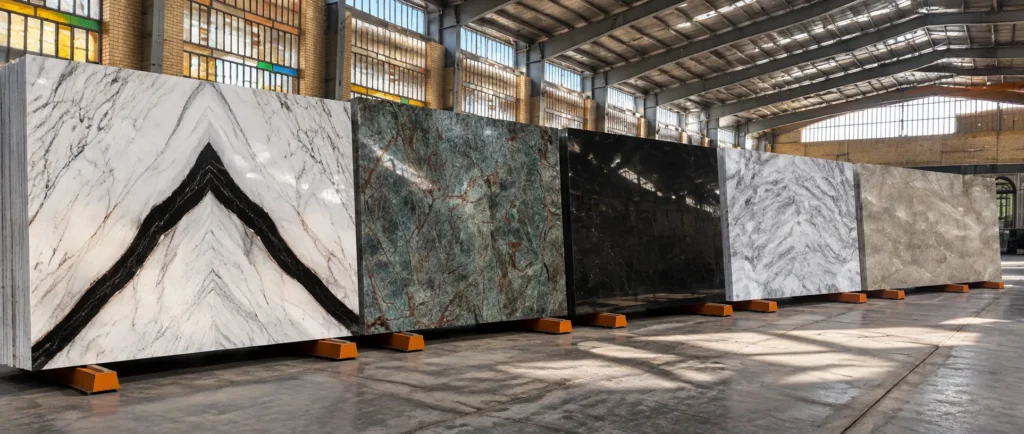
Color is the quickest way to narrow down the types of marble, and it’s a useful clue about behavior too. A stone’s color comes from the minerals inside it, so it hints at how the surface will show wear: light marbles tend to show stains and rust marks, while dark polished ones show scratches and etching. Treat the groups below as a starting point, and confirm any choice with a physical sample under the lighting of the actual room.
| Color family | Featured variety | Look | Best for | Watch out for | Finish tip |
|---|---|---|---|---|---|
| White | Bianco Carrara | Light background, soft grey veining | Bathrooms, wall cladding, bright interiors | Stains and rust marks show more | Honed |
| Black | Nero Marquina | Deep black, sharp white veins | Feature walls, lobbies, vanities | Scratches and etching show on polished surfaces | Polished for feature areas, honed for wear |
| Beige & cream | Crema Marfil | Even honey-beige, faint veining | Large floors, residential and hospitality | Shade can shift between batches | Honed or brushed |
| Brown | Dark Emperador Marble | Soft warm grey, subtle veining | Lobbies, hospitality, feature walls | Can feel heavy in small rooms | Polished or honed |
| Green | Royal Green | Deep brown-charcoal with white veins | Vanities, accent walls | Some green varieties are moisture-sensitive | Ask for installation advice |
Marble Uses and Applications
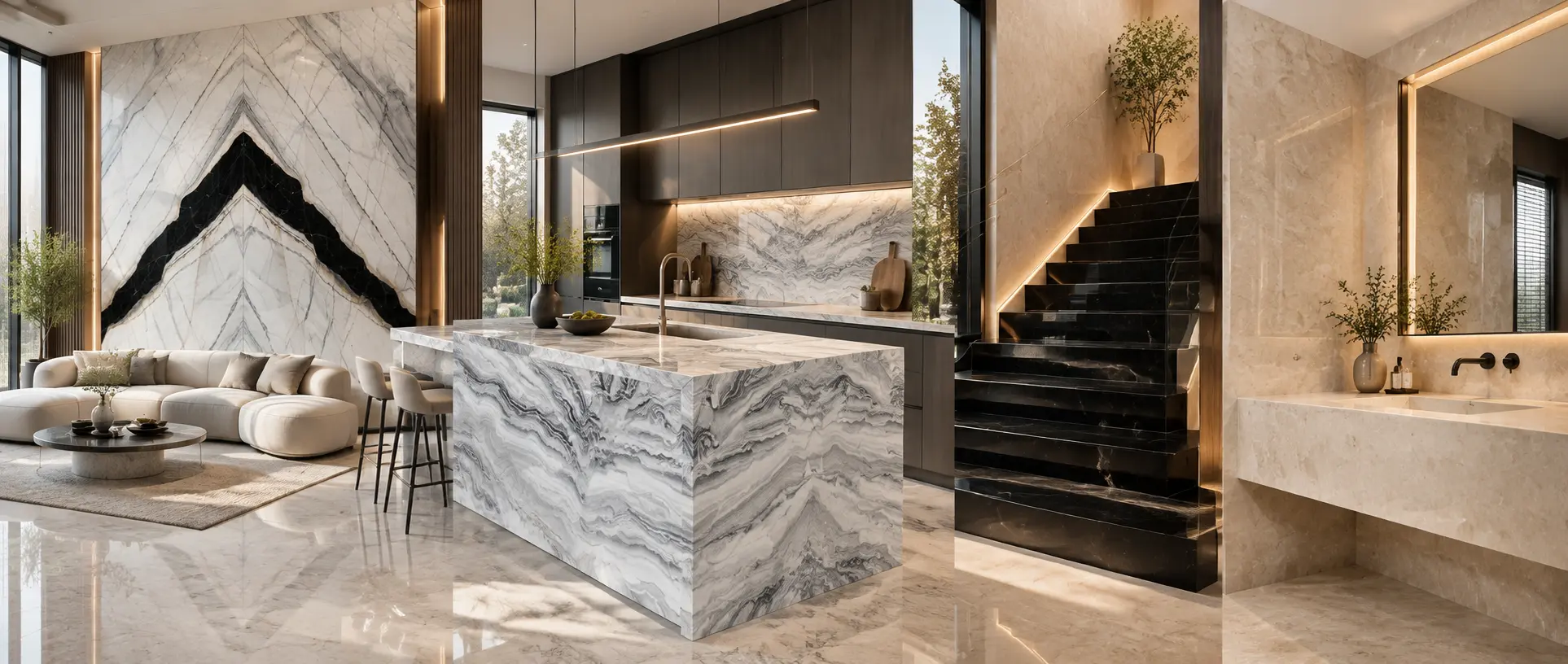
Marble stone works almost anywhere in a building, but the right stone and finish depend on the surface. This table shows which types of marble suit each use, and the short notes below explain the choices.
Marble Flooring
Marble flooring suits entrances, living areas and corridors, and it stays cool underfoot. Choose honed or brushed near doors, because wet polished marble is slippery. Even mid-tones hide dust and light scratches better than pure white or black, and a good doormat prevents most of the damage.
Marble Wall Cladding
Walls are the easiest place to use marble, because nothing walks on it. Pale, polished or boldly veined stones can be used freely. Panels are heavy and need suitable fixing, and if the design relies on veining across several panels, ask for book-matched slabs.
A sustainable choice for construction and interior design projects.
Marble Countertops & Kitchens
Among all the types of marble, darker and heavily veined stones live best in kitchens, because they camouflage etching. Etching is a chemical reaction with lemon, vinegar or wine, and sealer only slows staining, not etching. A honed finish shows it far less. If you want a surface that never changes, a harder stone may suit you better. Marble still works well for backsplashes, vanity tops and bar areas.
Marble in Bathrooms & Shower Walls
Light marble is a classic choice for bathroom vanities and shower walls. Use honed finishes on floors for grip. The waterproof membrane behind the stone protects the wall, not the marble itself, and acidic cleaners such as limescale removers will etch the surface. For steam showers, get installation guidance first.
Marble Stairs
Stairs need a slip-resistant finish (honed or brushed, often with a fine groove near the edge) and enough thickness for the span. Ask for a thickness recommendation for the specific stone, and check local slip-resistance rules. Risers can be polished and dramatic, because nobody steps on them.
Outdoor Marble & Exterior Facades
Not every one of the types of marble suits exteriors, especially in cold climates. Look for dense stone, low water absorption and good freeze-thaw results, and ask for the test data before specifying. For terraces and pool surrounds, choose a textured finish in a light color, which stays cooler underfoot. Facades are normally fixed with a mechanical system rather than glue.
Marble for Hotels & Commercial Projects
Traffic and scale change the rules. Honed, mid-tone marble types disguise wear better than polished white or black. On a large floor, shade differences show, so plan the whole area from one approved batch. Ask for the technical data sheet, including slip resistance, at specification stage, and budget for regular maintenance.
| Application | What matters most | Finish to consider | Color families that work well |
|---|---|---|---|
| Flooring | Wear, grip | Honed or brushed | Beige, grey, mid-tones |
| Wall cladding | Pattern, fixing method | Polished or honed | Any, bold veining suits feature walls |
| Countertops & kitchens | Etching, staining | Honed | Darker or heavily veined |
| Bathrooms & showers | Grip, moisture | Honed on floors | White, light grey |
| Stairs | Grip, edge durability | Honed or brushed treads | Mid-tone and dark, polished risers |
| Hotels & commercial | Traffic, consistency | Honed or brushed | Grey, mid-tone, dark |
From Quarry to Project: How Marble Is Produced?
Every slab you see in a showroom has been through a chain of decisions long before it reaches a building: where it was cut from, how it was sawn, how it was finished and what was rejected along the way. Knowing these steps helps you ask better questions, because production quality shows up later as consistency, fewer defects and fewer surprises on site. The table gives the overview, and the notes below explain each stage.
Quarrying & Block Selection
Marble is cut from the mountain in large blocks, usually with diamond wire saws or chain-cutting machines. Modern quarries avoid heavy blasting, because shock waves cause hidden cracks that only appear later, when the block is sawn. A commercial block typically weighs somewhere in the region of 15 to 30 tonnes. [Add your quarry’s location and typical block size here]
Not every block is worth cutting. Selection is where an experienced eye matters most: inspectors look for fractures, soft seams, unwanted color patches and veining that suits the intended type of stone. Blocks from the same quarry can differ, which is one reason color varies between batches.
Read more: Natural Stone Finishes explained: Polished, Honed, Tumbled & More
Cutting Slabs & Tiles
Blocks are sawn into slabs on gang saws or wire-cutting lines, most often in 2 cm or 3 cm thicknesses, although other thicknesses are possible. The cut direction changes the pattern: cutting across the veins gives a soft, cloudy look, while cutting along them gives a linear, streaked one. That’s why two slabs from the same block can look surprisingly different. [Add your available thicknesses]
Tiles are cut from slabs on bridge saws or cutting lines, then calibrated to a consistent thickness so they lay flat. Some veined marbles are reinforced with resin and mesh on the back to reduce breakage during handling. [Confirm whether you do this]
Finishing & Quality Control
Finishing gives the surface its character. Polishing lines use progressively finer abrasives to build gloss, while honed, brushed and other textured finishes are made with different tools. The finish you specify affects grip, visible wear and cleaning, so it’s worth choosing deliberately, and the next section explains how each one performs.
Quality control turns this into something you can rely on. Typical checks include dimensions and thickness tolerance, flatness, surface defects, cracks and edge condition, and color match against the approved sample. A good producer will show you how these checks are recorded and let you inspect the material before shipping. [Describe your own QC steps here]
Grading & Selection
After inspection, material is sorted into grades, usually based on how many visible flaws it has and how closely it matches the reference sample. The important point is that there’s no universal standard: what one producer calls “first choice” another may call “standard”. So when you compare offers across different types of marble or between producers, ask what the grade actually means, and get the criteria in writing
Choosing Between the Types of Marble
There’s no single best marble, only the right one for a particular surface. The easiest way to narrow the types of marble is to work in three steps. Start with color, which sets the mood and hints at how the surface will show wear. Then choose the finish, because honed, polished and brushed surfaces differ in grip, visible scratches and cleaning. Finally, check the application: a stone that’s perfect on a bathroom wall may not suit a busy floor, a kitchen worktop or a frosty exterior.
Whatever you shortlist, look at a physical sample under the light of the actual room, ask for the test data for the specific material, and approve the batch before the full order is cut. Those three habits prevent most of the disappointments people have with marble.
Frequently Asked Questions types of marble
What are the main types of marble?
The main types of marble are grouped by color: white (Carrara-style), black (Nero Marquina), beige and cream (Crema Marfil), grey, brown, and green or pink. White suits bathrooms and walls, beige suits large floors, and darker stones handle busy areas well.
Is marble a good choice for kitchen countertops?
Yes, if you accept some change over time. Acids like lemon and vinegar leave dull marks called etches, and sealing doesn’t prevent them. A honed finish or darker, veined stone hides them best.
Which is better: polished or honed marble?
Polished is glossy and best for walls and vanity tops. Honed is matte, hides scratches better and is less slippery, so it suits floors, bathrooms and stairs.
What is the difference between marble and granite?
Marble is softer (3 to 4 on the Mohs scale) and more refined in look. Granite is harder (6 to 7), and resists scratches and acids better. See our guide to limestone vs marble vs granite for a full comparison.