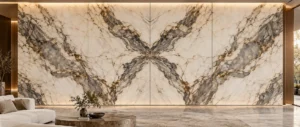
Natural stone becomes more than a finishing material when its patterns are used as part of the architectural design. Bookmatched marble creates this effect by arranging consecutive slabs in mirrored compositions, transforming natural veins into symmetrical patterns that draw attention and define the visual character of a space.
For architects and interior designers, bookmatched marble slabs offer opportunities to create distinctive feature walls, elegant hotel lobbies, luxury bathrooms, and fireplace surrounds. The mirrored patterns can establish a strong focal point while maintaining a sense of balance and continuity within the overall design.
However, achieving a successful bookmatched arrangement requires careful slab selection. The continuity of natural veining, slab dimensions, cutting sequence, and material quality all influence how accurately the desired pattern can be achieved.
This guide explores the architectural applications of bookmatched marble, explains how these mirrored patterns are created, and outlines the essential factors for selecting suitable slabs. It also highlights how MOT Stone supports architects, interior designers, and international buyers in sourcing natural stone slabs for bookmatched projects.
What Is Bookmatched Marble and How Is It Created?
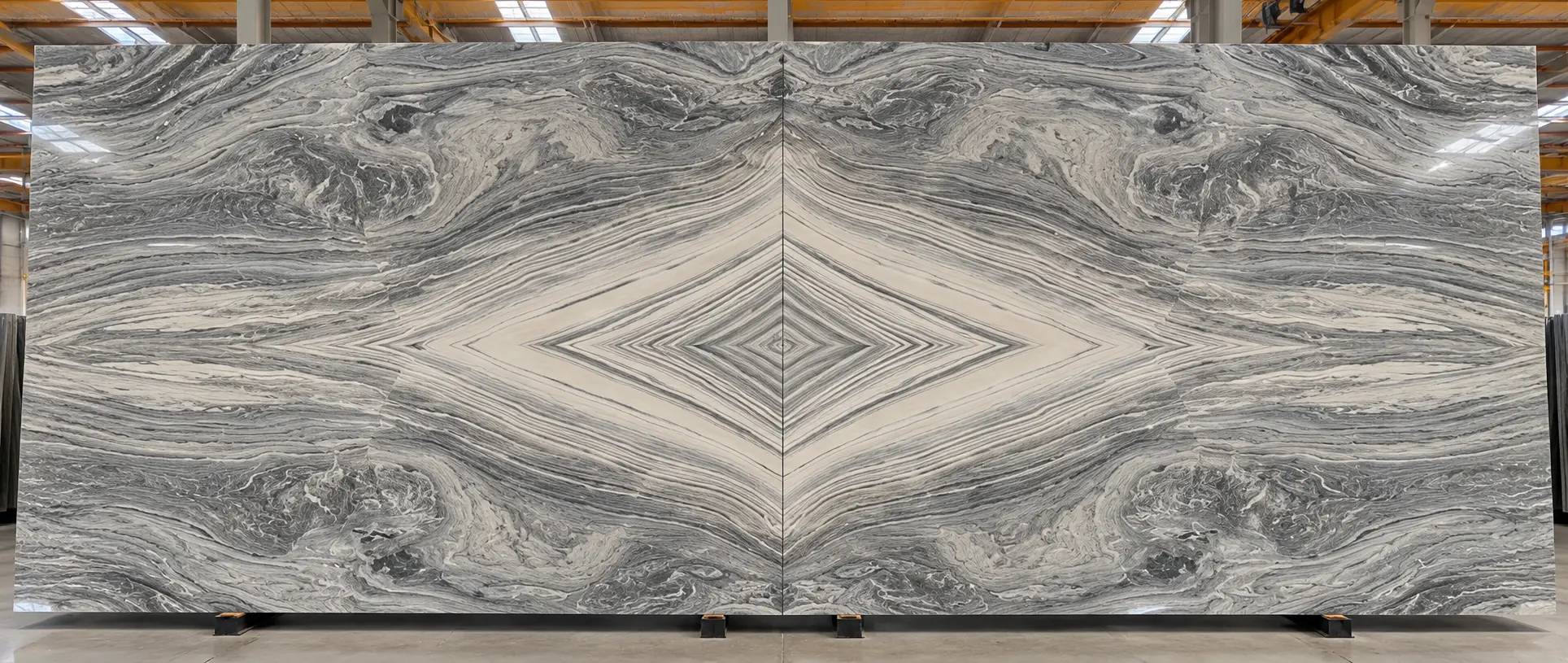
Bookmatched crystal marble is a natural stone arrangement in which two consecutive slabs are positioned side by side to create a mirrored pattern. The veins and mineral formations of one slab visually reflect those of the adjacent slab, producing a symmetrical composition similar to the pages of an open book.
This technique highlights the natural patterns of marble and transforms them into a central architectural feature rather than a conventional surface finish.
How Is Bookmatched Marble Created?
The process begins with cutting consecutive slabs from the same stone block. Because the slabs come from adjacent sections, their natural veining and patterns are closely related.
To create the mirrored effect, the slabs are processed and arranged so that the corresponding faces form a symmetrical composition. The key stages include:
- Sequential Slab Cutting: Consecutive slabs are cut from the same block to preserve continuity in the natural veining.
- Matching Surface Preparation: The appropriate faces are finished to achieve a mirrored appearance when the slabs are placed together.
- Pattern Alignment: The slabs are positioned and adjusted to align the veins and create the intended symmetrical design.
- Final Layout Approval: The complete arrangement is reviewed before installation to confirm visual continuity and pattern balance.
What Makes Each Bookmatched Pattern Unique?
The appearance of bookmatched marble slabs depends on the stone’s natural veining, mineral distribution, and cutting direction. Some arrangements create subtle, flowing symmetry, while others produce dramatic patterns with strong visual contrast.
Because no two natural stone blocks have identical internal patterns, each bookmatched composition has a distinctive appearance. For architects and designers, this makes slab selection particularly important when planning large decorative surfaces.A successful bookmatch is defined not simply by symmetry, but by how the mirrored stone patterns complement the proportions and architectural character of the space.
Best Bookmatched Marble Applications in Architecture
Bookmatched marble slabs are used in architectural projects where natural stone patterns become a central part of the design. Their symmetrical veining makes them particularly suitable for large surfaces and spaces that require a distinctive visual focal point.The following applications demonstrate how bookmatched marble can be incorporated into residential, hospitality, and commercial interiors.
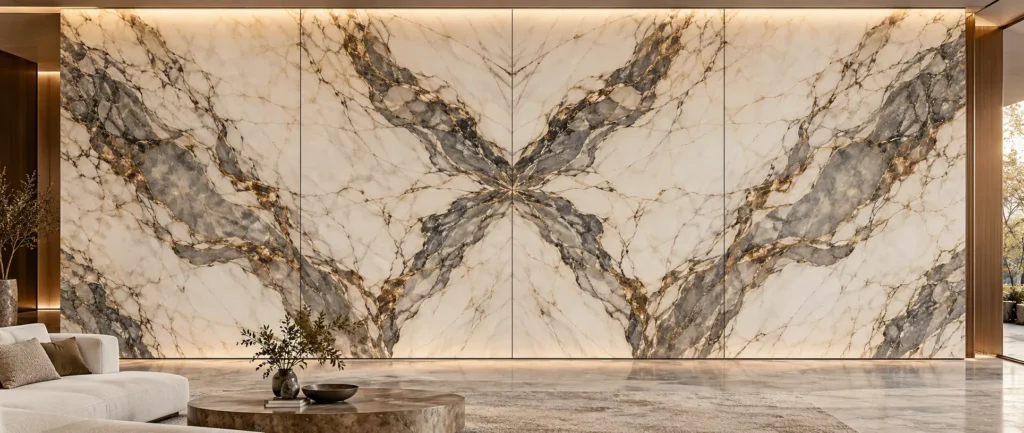
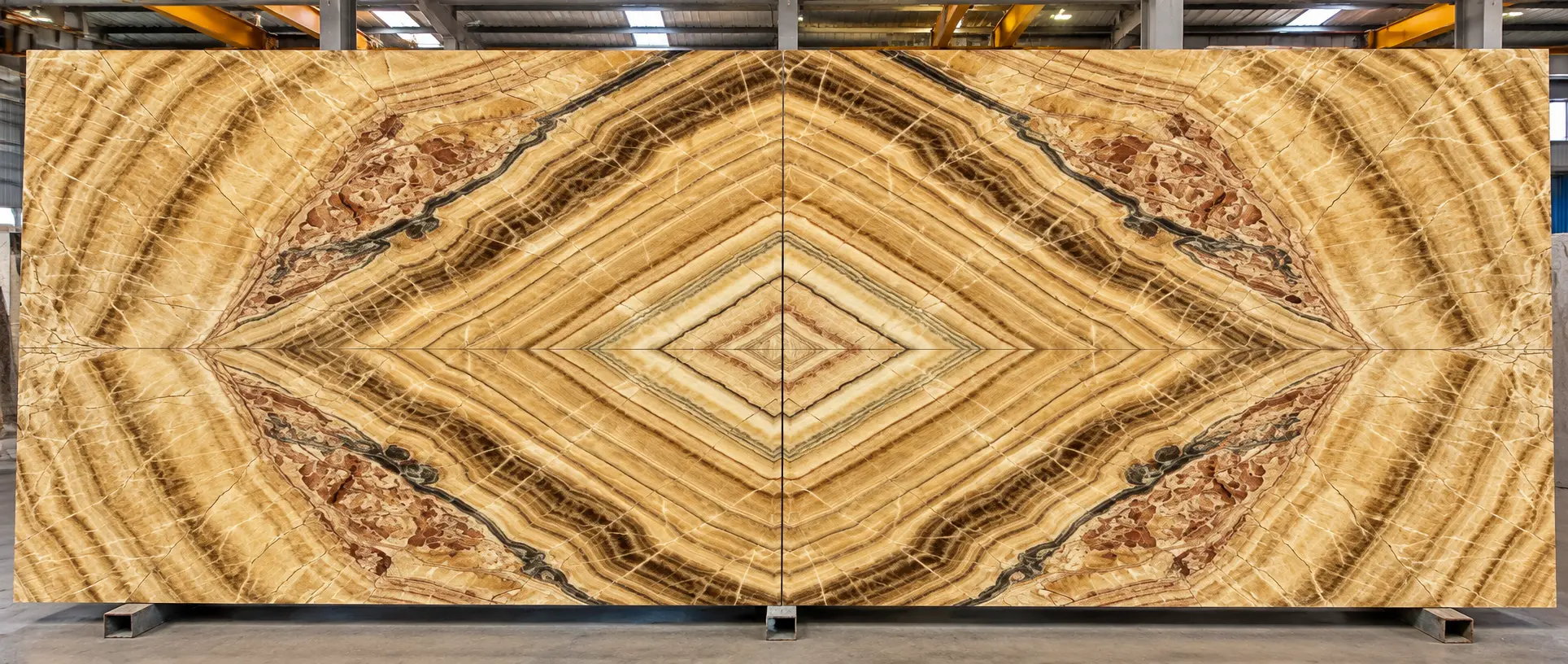
Bookmatched Marble Feature Walls
Feature walls are among the most popular applications of bookmatched marble. Large, mirrored slabs can create a striking focal point in living rooms, entrance halls, and luxury commercial interiors.
For the best visual result, architects should consider the wall’s dimensions, viewing distance, and slab arrangement. Centering the mirrored pattern on the main viewing axis can create a more balanced composition, while minimal joints help preserve the continuity of the veins.
Bookmatched Marble in Hotel Lobbies
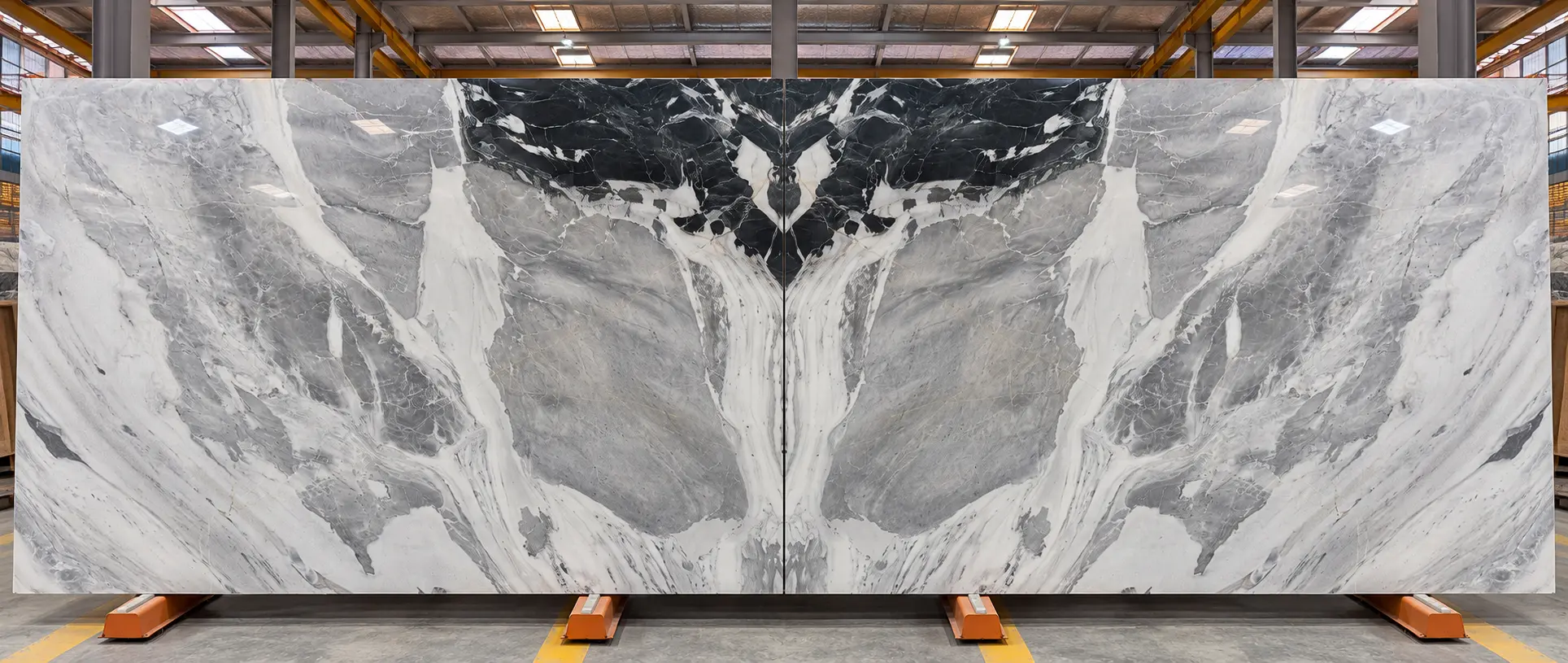
In luxury hotel lobbies, bookmatched marble can be used behind reception desks, on entrance walls, or across large decorative surfaces.These installations can establish a distinctive visual identity and reinforce the architectural character of the interior. Combining bookmatched stone with understated furniture, controlled lighting, and complementary materials helps maintain a balanced design.
For large installations, the availability of matching slabs and careful planning of the overall layout are especially important.
Bookmatched Marble for Bathrooms
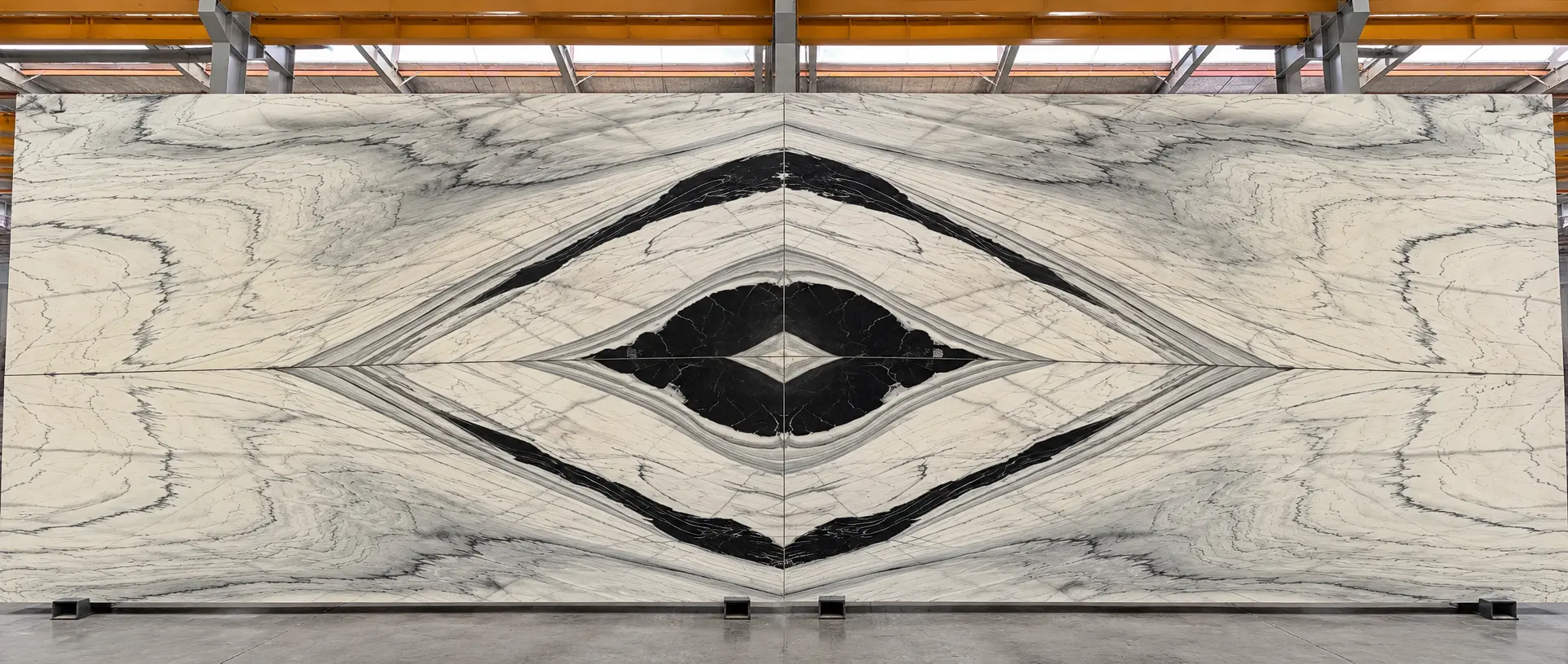
Bookmatched marble is often incorporated into luxury bathrooms as a decorative feature behind freestanding bathtubs, vanity areas, or selected wall surfaces.The mirrored patterns can add visual depth without requiring additional decorative elements. However, designers should consider moisture exposure, appropriate sealing, and maintenance requirements when specifying marble for bathroom applications.
Bookmatched Marble Fireplace Surrounds
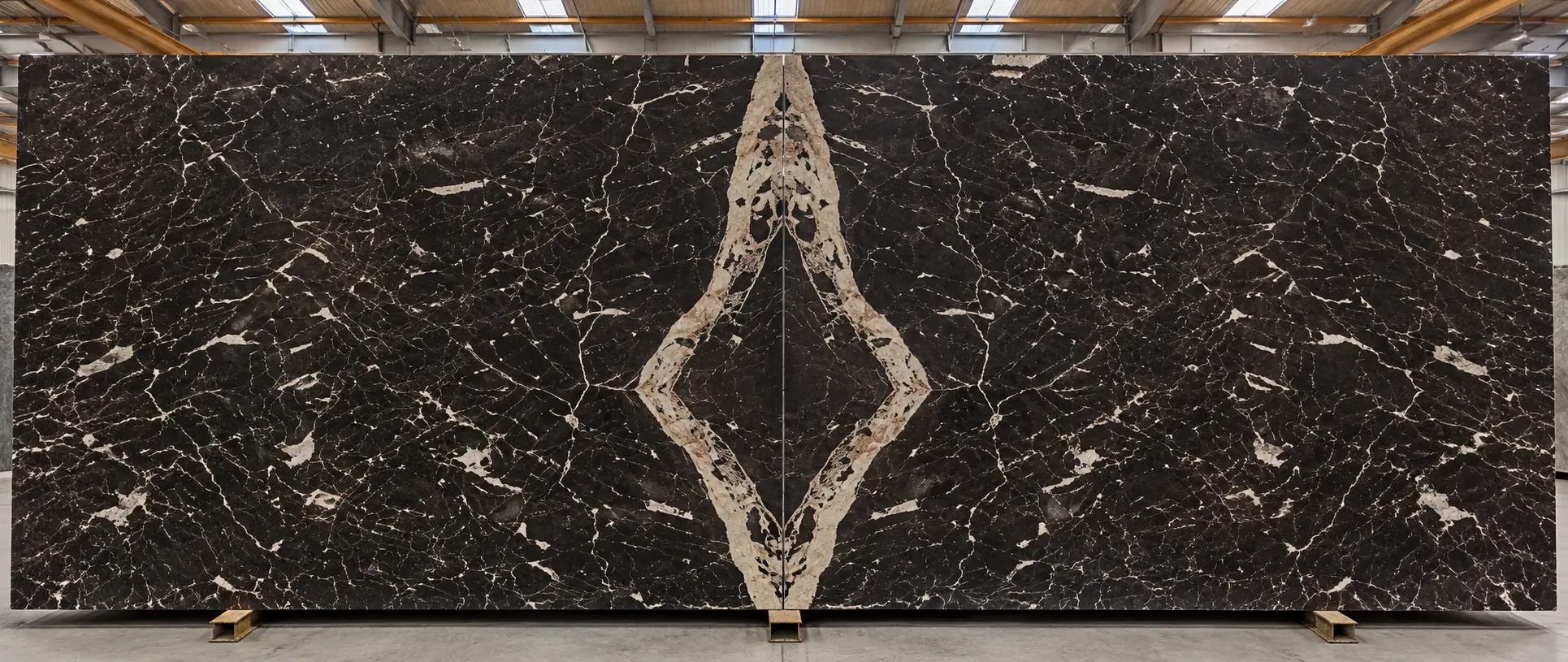
Fireplace surrounds provide an opportunity to use bookmatched marble as a central architectural feature. Symmetrical veining can frame the fireplace opening and create a cohesive composition across the surrounding wall.
The selected stone should complement the fireplace’s proportions and nearby materials. For functional fireplaces, the stone, adhesives, mounting system, and installation details must also be suitable for the expected temperatures.
Choosing the Right Application
The most effective bookmatched marble applications are those where the mirrored pattern supports the proportions and overall composition of the space.For a quick comparison, the table below highlights the main design priorities for each application.
| Application | Main Design Benefit | Key Consideration |
|---|---|---|
| Feature Walls | Creates a prominent visual focal point | Pattern centering and vein alignment |
| Hotel Lobbies | Establishes a distinctive architectural identity | Matching slab availability and overall scale |
| Luxury Bathrooms | Adds depth and symmetry to decorative surfaces | Moisture exposure and maintenance |
| Fireplace Surrounds | Frames the fireplace with symmetrical natural patterns | Heat compatibility and installation requirements |
Selecting the appropriate location and approving the complete slab arrangement before installation helps ensure that the finished bookmatched surface matches the intended architectural design.
How to Choose the Right Bookmatched Marble Slabs
Selecting the right bookmatched marble slabs requires more than choosing an attractive color or veining pattern. Architects, interior designers, and stone buyers must evaluate how the slabs will appear together, whether their dimensions suit the installation area, and whether the material meets the project’s technical requirements.
Unlike conventional marble installations, bookmatched arrangements depend on the relationship between adjacent slabs. Even small differences in vein alignment, surface appearance, or dimensions can affect the final composition.
The following factors should be carefully evaluated before approving slabs for a bookmatched marble project.
Natural Veining and Pattern Symmetry
Natural veining is one of the most important factors when selecting bookmatched marble. The position, direction, and intensity of the veins determine how effectively the slabs create a mirrored composition.
Some marble blocks feature bold, contrasting veins that produce dramatic symmetrical patterns. Others have softer, more delicate formations that create a subtle and balanced appearance.When reviewing bookmatched marble slabs, consider whether the veins connect naturally across the central joint and whether the overall pattern complements the dimensions of the intended surface.
For large feature walls, reviewing a complete slab layout rather than individual slab photographs can help architects evaluate the final visual effect before installation.
Slab Dimensions and Thickness
The dimensions of bookmatched marble slabs should be selected according to the size and proportions of the installation area. Larger slabs can reduce the number of visible joints and help preserve the continuity of natural veining.Before ordering, buyers should confirm the usable dimensions of each slab, accounting for edge trimming, cutting requirements, and any openings within the design.
Slab thickness is another important consideration. The appropriate thickness depends on the application, installation method, structural support, and project specifications.For large vertical installations, architects and installers should assess slab weight, handling requirements, and the suitability of the supporting structure before finalizing the material selection.
Read more: Types of Marble: The Complete Guide to Colors, Finishes & Uses (2026)
Color Consistency and Surface Finish
Although bookmatched slabs are cut from the same natural stone block, variations in color intensity, mineral distribution, and background tone may still be visible.These differences are characteristic of natural marble, but they should be evaluated carefully when the design requires a balanced and symmetrical appearance.
Surface finish also influences the visual impact of a bookmatched arrangement. Polished marble generally enhances color depth and vein contrast, while honed finishes create a softer, less reflective appearance.For the most consistent result, all slabs within the same composition should be evaluated under similar lighting conditions and approved with the intended surface finish in mind.
Slab Quality and Structural Integrity
Visual appearance should not be the only criterion when selecting bookmatched marble slabs. The physical condition of the material is equally important, particularly for large architectural installations.
Buyers should examine the slabs for visible cracks, open fissures, significant surface defects, and areas that may require reinforcement or additional processing.Natural marble may contain veins, filled sections, or other geological characteristics that do not necessarily make the stone unsuitable. However, their location and extent should be assessed in relation to the intended application.For demanding installations, the stone supplier and project team should also consider relevant material properties, fabrication requirements, and installation conditions.
Matching Consecutive Slabs from the Same Block
A successful bookmatched arrangement depends on selecting slabs that have been cut consecutively from the same stone block and processed to reveal corresponding mirrored patterns.Even when slabs share similar colors and veining, they may not produce an accurate bookmatch unless their cutting sequence and finished faces are compatible.
Before confirming an order, buyers should request photographs of the actual slabs arranged in their proposed installation sequence. This allows the project team to evaluate pattern continuity, central alignment, and the overall composition.
For projects requiring multiple bookmatched pairs, identifying and reserving the complete set of suitable slabs before fabrication can help reduce the risk of unexpected pattern variations or material shortages.Careful evaluation of these factors helps ensure that the selected bookmatched marble slabs meet both the visual expectations and practical requirements of the architectural project.
Conclusion: Choosing Bookmatched Marble Slabs for Your Project
Bookmatched marble slabs offer a distinctive way to incorporate natural stone into architectural design. From luxury feature walls and hotel lobbies to bathrooms and fireplace surrounds, their mirrored veining creates visually balanced compositions that enhance the character of a space.
Achieving the desired result depends on selecting suitable marble, evaluating natural vein patterns, confirming slab dimensions, and reviewing the complete layout before fabrication. Careful planning helps ensure that the finished installation meets both aesthetic expectations and technical requirements.
At MOT Stone, we help architects, designers, and international buyers source natural marble slabs for residential and commercial projects. Explore our marble collection or contact our team to discuss slab availability, dimensions, finishes, and project requirements.
Frequently Asked Questions About Bookmatched Marble Slabs
What is the difference between bookmatched and four-matched marble?
Bookmatched marble typically uses two consecutive slabs arranged to create a mirrored pattern along a central joint. Four-matched marble uses four coordinated slabs to form a symmetrical composition across horizontal and vertical axes. Four-matched arrangements are particularly suitable for larger decorative surfaces.
Is bookmatched marble more expensive than regular marble?
Bookmatched marble installations are generally more expensive than standard marble arrangements because they require carefully selected consecutive slabs, additional processing, precise pattern alignment, and potentially more material. The final cost depends on the marble type, slab dimensions, finishing requirements, and project complexity.
Can any marble slab be bookmatched?
Not every marble slab is suitable for an effective bookmatched arrangement. Successful bookmatching requires compatible consecutive slabs from the same block and appropriate surface processing. Marble with distinctive directional veining typically produces more noticeable mirrored patterns.
What are the best marble types for bookmatching?
Marble varieties with strong, continuous veining and contrasting colors are often preferred for bookmatching. Calacatta, Arabescato, and certain dark-veined marbles can create striking symmetrical compositions. However, the suitability of any marble depends on the actual block patterns and availability of matching slabs.
How many marble slabs are needed for a bookmatched wall?
A standard bookmatched arrangement requires two compatible slabs. Larger feature walls may require multiple coordinated pairs, depending on the wall dimensions, usable slab sizes, and intended pattern. A detailed layout should be prepared before cutting to confirm the required quantity.